B2B vs B2C Marketing is one of the most important concepts to understand before planning any marketing campaign. Many businesses assume that if a strategy works for one company, it will work for another. In reality, marketing success depends on understanding who you're trying to reach. Business buyers and everyday consumers think differently, research differently, and make purchasing decisions for different reasons.
At Sparktics, we believe great marketing begins with understanding people before choosing platforms, content, or advertising channels.
Understanding Your Audience Comes First
Every successful marketing campaign starts with one simple question: Who is your audience?
If you're selling to another business, your customers are likely looking for expertise, long-term value, and practical solutions. If you're selling directly to consumers, your audience is more likely to respond to convenience, emotion, pricing, and brand experience.
This is where B2B Digital Marketing and B2C Digital Marketing begin to take different paths. Although the goal is the same — attracting customers — the journey to reach them is completely different.
How Buying Decisions Differ
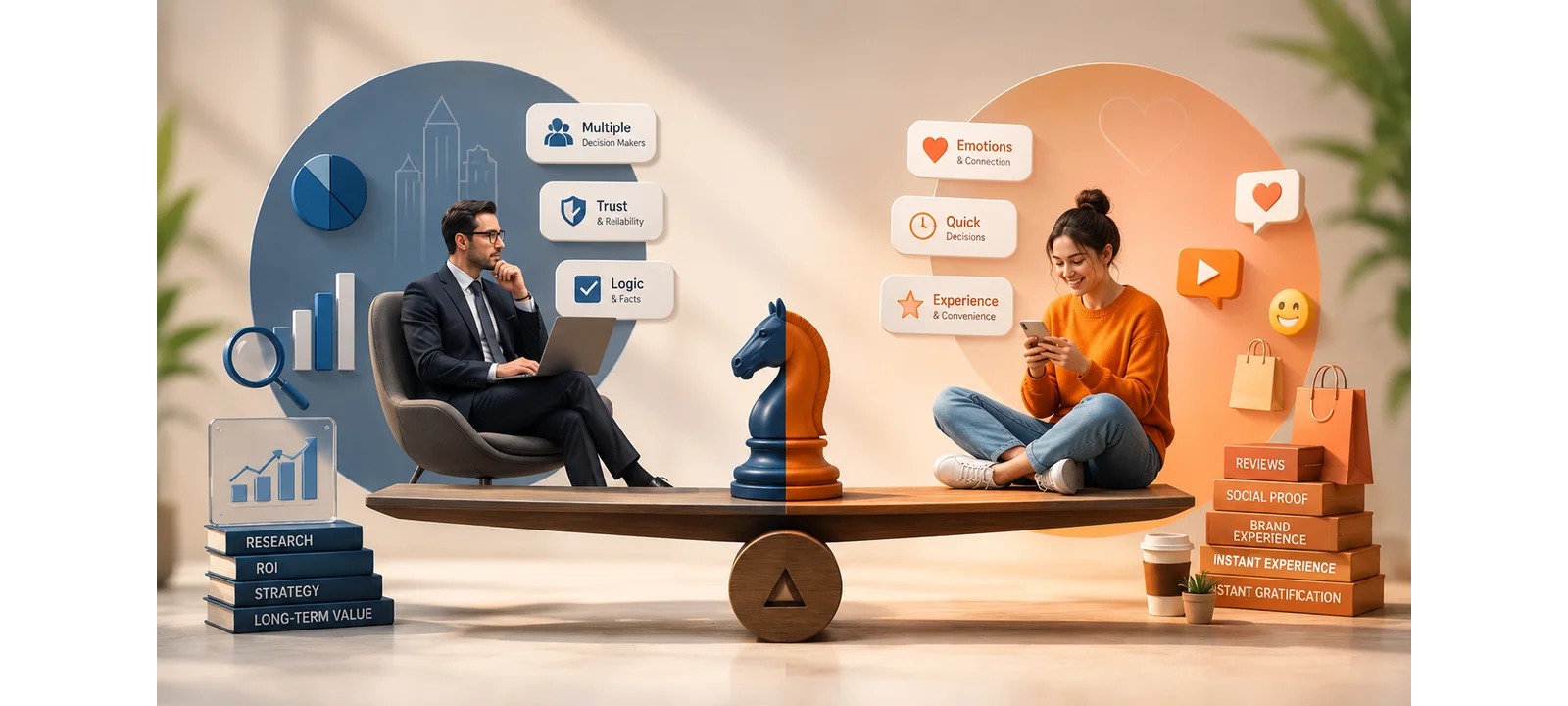
The biggest difference between business buyers and consumers is how they make decisions.
A B2C customer might see a product on Instagram at 7 PM, like what they see, check the reviews, and place an order before dinner.
Neither behaviour is unusual. They're simply responding to different situations.
This is why B2B Digital Marketing and B2C Digital Marketing cannot be approached with the exact same playbook.
A business buyer often needs to justify a purchase. A consumer often needs to feel good about one.
That small difference changes almost everything—from the content you create to the way you write an ad.
In B2B, the Sale Usually Needs a Little More Convincing
Think about buying a ₹500 pair of shoes.
You might look at the design, check the price, read a few reviews, and make a decision.
Now imagine your company is considering spending ₹5 lakh on software.
Suddenly, the questions become very different.
Will it integrate with existing systems? What happens after implementation? Is the pricing worth it? Can the team use it easily? What kind of support is available? Will it actually solve the problem?
There may also be multiple people involved in the decision.
That's why a good B2B Marketing Strategy isn't constantly shouting, "Buy now!"
It gives potential customers reasons to believe the product is worth considering.
A useful blog can answer an early question. A case study can show what happened for another customer. A webinar can demonstrate expertise. A product comparison can remove doubts. Testimonials can provide reassurance.
The sale is still the destination. But the journey often involves much more education and trust-building.
B2C Has a Different Kind of Challenge
Now flip the situation.
Imagine you're scrolling through Instagram and a skincare brand catches your attention. The packaging looks great. The video is satisfying. Someone explains how the product works in 20 seconds. You check the reviews, notice a limited-time offer, and suddenly you're thinking, "Okay, maybe I need this."
That's where B2C Digital Marketing often has an advantage: the path from attention to action can be much shorter.
But shorter doesn't mean easier.
Consumers are surrounded by brands competing for their attention every day. They can scroll past your advertisement in half a second.
So a successful B2C Marketing Strategy often needs to make people stop, feel something, understand the value quickly, and have a reason to act.
That could come through humour, relatability, aspiration, urgency, entertainment, convenience, or simply a really good product demonstration.
The important part is knowing what your audience actually responds to.
So, Should B2B Be Serious and B2C Be Fun?
Not necessarily.
This is where marketers often fall into another trap.
B2B doesn't have to sound like a corporate presentation.
And B2C doesn't have to be a constant stream of jokes, trends, and flashy videos.
A business buyer is still a human being. They can appreciate humour, storytelling, strong visuals, and personality.
Likewise, a consumer can appreciate detailed information when they're considering an expensive or complicated purchase.
The real question isn't:
"Is this B2B or B2C content?"
It's:
"What does this particular audience need to feel confident about choosing us?"
That's a much more useful question.
Content Should Follow the Buying Behaviour
Once you understand that, content strategy becomes easier.
A B2B brand might need to answer questions such as:
"Can I trust this company?"
"Do they understand my industry?"
"Has this worked for someone like me?"
"Is this worth the investment?"
That's why long-form blogs, research reports, case studies, webinars, LinkedIn content, demos, and expert-led content can work so well in B2B.
A consumer brand might have a different set of questions:
"Does this look good?"
"Will it make my life easier?"
"Do other people like it?"
"Can I get it quickly?"
That naturally creates space for reels, product videos, testimonials, influencer content, social posts, offers, and visually engaging campaigns.
The formats may be different, but the principle is exactly the same:
Give people the information or feeling they need at the moment they need it.
The Platform Isn't the Strategy
There's another common misconception: LinkedIn is for B2B and Instagram is for B2C.
It's a useful shortcut, but it's not a marketing strategy.
A B2B company can absolutely build an audience on Instagram. A consumer brand can use LinkedIn successfully. YouTube can work for both. Email can work for both. Search can work for both.
The better question is where your audience actually spends time and what they expect to see there.
A B2B brand might use LinkedIn to establish expertise, YouTube to explain complex products, and search campaigns to capture high-intent prospects.
A B2C brand might use Instagram for discovery, Google for purchase intent, and email to bring customers back.
The channel matters.
But the reason you're using the channel matters more.
The Real Difference Between B2B and B2C Marketing
If you strip everything else away, the biggest difference comes down to the buying journey.
B2B purchases often involve more time, more research, more people, and more justification.
B2C purchases can often involve more emotion, faster decisions, personal preferences, and convenience.
But there is an important overlap.
Both buyers want to feel understood.
A business owner doesn't want generic marketing that could have been written for any company.
A consumer doesn't want to feel like another number in a database.
Both want relevant information. Both look for trust. Both notice whether a brand understands their problem.
And both can tell when a marketing message feels like it was written by someone who never bothered to understand them.
Stop Asking Which Strategy Is Better
There is no universal winner in the B2B vs B2C Marketing debate.
A B2B approach isn't automatically more sophisticated. A B2C approach isn't automatically more creative.
They're simply solving different marketing problems.
If you're selling enterprise software, you probably shouldn't rely entirely on a flashy Instagram post and a "Buy Now" button.
If you're selling everyday consumer products, you probably don't need a 40-page whitepaper before someone can purchase.
The smartest marketers don't copy what another company is doing just because it worked for them.
They ask:
Who are we talking to?
What are they trying to solve?
What might stop them from buying?
What would make them trust us?
And what kind of message would actually make sense to them?
Those questions are where effective marketing begins.
At Sparktics, We Start With the Audience
Marketing becomes much easier when you stop trying to make everyone respond to the same message.
Whether you're building a B2B Marketing Strategy for a company selling complex solutions or developing a B2C Marketing Strategy for a consumer brand, the foundation remains the same: understand the audience first.
From there, the content, creative direction, platforms, campaigns, and messaging can start working together instead of operating as disconnected pieces.
Because at the end of the day, B2B and B2C aren't just two different marketing categories.
They're two different ways people make decisions.
And the better you understand those decisions, the better you can market to them.
The Takeaway
The biggest lesson from B2B vs B2C Marketing is surprisingly simple: don't market to the category. Market to the person.
A business buyer may need more proof before saying yes. A consumer may need more excitement. One might want a detailed case study while the other wants to see a product in action.
Your job isn't to force both into the same funnel.
It's to understand what moves each audience forward and build your marketing around that.
Because the best marketing strategy isn't the one that reaches the most people.
It's the one that makes the right people feel, "This is exactly what I was looking for."